
<> Junonia iphita (Cramer,[1779]) <>
the Chocolate Pansy ผีเสื้อแพนซีตาลไหม้
Click on any photo to see all photos full size in Lightbox
Additions and corrections to the information provided on this page is always welcome. Please use the Contact form.
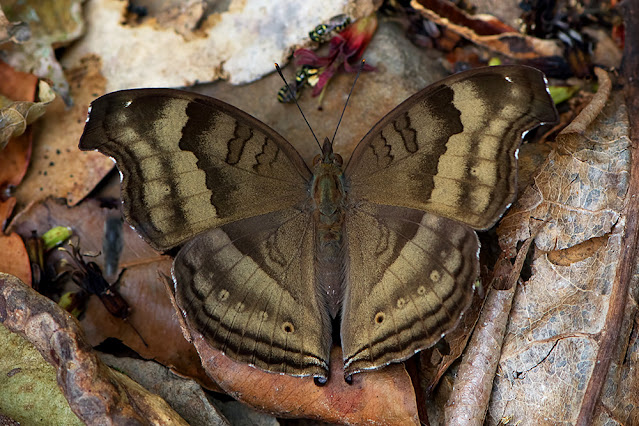
Photo taken at Chiang Dao Nature Sanctuary, Chiang Mai, Thailand. 540m a.s.l.

Junonia iphita is distributed widely across the region and although generally found at low to medium elevations it has been recorded at 4000m altitude in Bhutan. Depth of colour on the wings varies but there is little difference visually between the sexes. It is primarily a forest species and unlike others of this genus rarely visits gardens. It basks, with wings widespread, on low foliage or amongst the leaf litter where it is difficult to spot. It is a strong flier. The species is multivoltine with several generations per annum.
Synonyms and previously used names: Precis iphita, Precis hopfferi
Taxonomy: Animalia - Arthropoda - Insecta - Lepidoptera - Nymphalidae - Nymphalinae - Junonia - iphita
Regional Distribution: India, Nepal, Bhutan, Bangladesh, Myanmar, Thailand, Laos, Cambodia, Vietnam, China, Malaysia, Indonesia, Philippines
Habitat: primary and secondary forest, riverbanks, up to 4000m a.s.l.
Flight time: all year, depending on location Wingspan: 40-60mm
Life History: egg 3 days instar 1 3 days instar 2 3 days instar 3 2 days instar 4 2 days instar 5 3 days instar 6 4 days pupa 7 days Total egg to adult 24-28 days.
All times are approximate and can vary depending on the season and on the host used.
Larval Hosts: Barleria cristata, Barleria prionitis, Eranthemum capense, Hygrophila auriculata, Justicia adhatoda, Justicia micrantha, Lepidagathis formosensis, Rostellularia procumbens, Ruellia patula, Ruellia prostrata, Ruellia simplex, Ruellia tuberosa, Strobilanthes auriculata, Strobilanthes callosa, Strobilanthes ciliata, Strobilanthes diandra, Strobilanthes formosana, Strobilanthes pavala, Strobilanthes tomentosa (Acanthaceae), Sida cordifolia (Malvaceae)
Actual host plant used depends upon location and availabilty of plant species.
Adult Food Sources: Nectar - Duranta erecta, Duranta repens, Lantana camara, Verbena rigida (Verbenaceae), Leucas lamiifolia, Plectranthus barbatus, Premna serratifolia, Rotheca serrata (Lamiaceae), Ageratina adenophora, Ageratum conyzoides, Bidens pilosa, Chromolaena odorata, Crassocephalum cerpidioides, Eupatorium inulifolium, Gynura nitida, Helichrysum bracteatum, Mikania micrantha, Parthenium hysterophorus, Sphagneticola trilobata, Synedrella nodiflora, Taraxacum javanicum, Vernonia conyzoides, Youngia japonica (Asteraceae), Cordia cylindrostachya (Boraginaceae), Cytisus scoparius, Tephrosia purpurea (Fabaceae), Cestrum aurantiacum, Solanum mauritianum (Solanaceae), Hypericum japonicum, Hypericum mysorense (Hypericaceae), Justicia japonica (Acanthaceae), Sida acuta (Malvaceae), Oplismenus undulatifolius (Poaceae), Oxalis latifolia (Oxalidaceae), Verbascum thapsus (Scrophulariaceae), Trichilia connaroides (Meliaceae), Nothapodytes nimmoniana (Icacinaceae), Rhodomyrtus tomentosa (Myrtaceae), Oenothera rosea (Onagraceae), Prinsepia utilis, Rubus ellipticus (Rosaceae), Rhamnus wightii (Rhamnaceae), Euphorbia milii, Euphorbia rothiana (Euphorbiaceae), Catheranthus roseus (Apocynaceae), Antigonon leptopus (Polygonaceae), Anacardium occidentale (Anacardiaceae), Santalum album (Santalaceae), Zanthoxylum avicennae (Rutaceae), Berberis chitria, Berberis lycium (Berberidaceae). Other - over-ripe fruit, animal dung
 |
| Doi Suthep-Pui N.P., Chiang Mai, Thailand |
 |
| Lamnamkok N.P., Chiang Rai, Thailand |
 |
| Doi Suthep-Pui N.P., Chiang Mai, Thailand |
 |
| Lamnamkok N.P., Chiang Rai, Thailand |
 |
| Lamnamkok N.P., Chiang Rai, Thailand |
 |
| Chromolaena odorata, a nectar source |
 |
| Barleria cristata, a regular larval host |
 |
| Ruellia tuberosa, another larval host |
Links to other pages in this series for species in the same subfamily
Junonia iphita
Kaniska canace
Vanessa cardui
