
<> Symbrenthia hypatia (Wallace,1869) <>
the Intricate Jester ผีเสื้อลายตลกขีดยุ่ง
Click on any photo to see all photos full size in Lightbox
Additions and corrections to the information provided on this page is always welcome. Please use the Contact form.
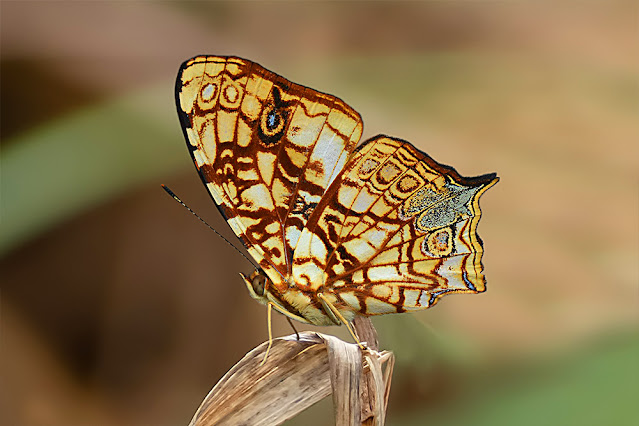
Photo taken in Tenasserim, Myanmar. 380m a.s.l.

Symbrenthia hypatia is quite rare and only sparsely distributed across the southern part of the region. It also appears in the checklist for Laos but all other records are from much further south. This is another of those species about which very little is known. It seems to like the sunshine and is usually seen at forest edges and in sunny spots within open forest. Visually there is little difference between the sexes. It is quite timid and can be difficult to approach.
The species is thought to be multivoltine with several broods per annum. Eggs are usually laid in clusters on the underside of host plant leaves, although sometimes singly. The larvae are gregarious when feeding on host plant leaves. They also exhibit behaviors like leaf-folding for shelter in later instars
Synonyms and previously used names: Laogona hypatia, Symbrenthia chersonesia, Symbrenthia hippocrene
Taxonomy: Animalia - Arthropoda - Insecta - Lepidoptera - Nymphalidae - Nymphalinae - Symbrenthia - hypatia
Regional subspecies: Symbrenthia hypatia hypatia (Indonesia), Symbrenthia hypatia chersonesia (S.Thailand, Laos, W.Malaysia, Sumatra-Indonesia), Symbrenthia hypatia ?hippocrene (E.Malaysia), Symbrenthia hypatia mindanaensis (Philippines)
Regional Distribution: Myanmar, Thailand, Laos, Malaysia, Indonesia, Philippines
Habitat: Symbrenthia hypatia is found in primary and secondary rainforests, forest margins and open woodland. It is usually seen at moderate elevations but has been recorded up to 1200m a.s.l.
Flight time: not known but possibly excluding the colder months Wingspan: 30-45mm
Life History: not fully known but eggs hatch after 5-6 days and the larval stage is thought to be around 16-19 days.
Larval Hosts: not known but likely to be from the Urticaceae family of plants, similar to other members of this genus.
Adult Food Sources: Nectar - Chromolaena odorata (Asteraceae). There may be other sources but not known at present. Other - mud puddling
 |
| Tenasserim, Myanmar |
 |
| Chromolaena odorata, a nectar source |
Links to other pages in this series for species in the same subfamily
