
<> Euploea radamanthus (Fabricius, 1793) <>
the Magpie Crow ผีเสื้อจรกาดำขาว
Click on any photo to see all photos full size in Lightbox
Additions and corrections to the information provided on this page is always welcome. Please use the Contact form.
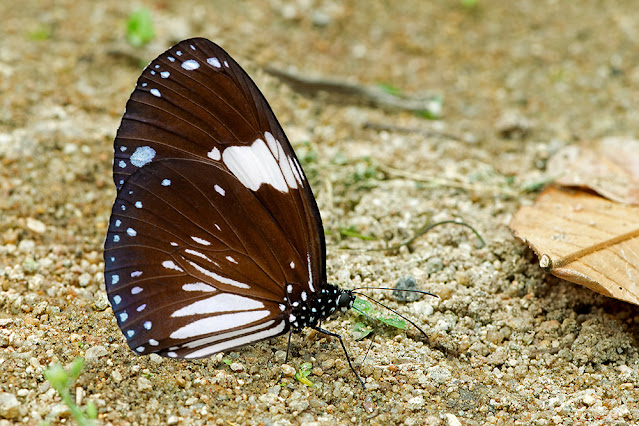
Photo taken at Khao Phanom Bencha National Park, Krabi, Thailand. 100m a.s.l.

Although uncommon, Euploea radamanthus is quite widespread throughout the region. Very little research appears to have been done into this species. Both sexes are similar in appearance but the background colour is slightly different and the female has larger areas of white on her wings. She is also slightly smaller in size. Males are more often seen than the females. They are also very skittish and difficult to approach.
Synonyms and previously used names: Euploea diocletianus, Euploea maasseni, Papilio diocletianus, Papilio radamanthus, Danais rhadamia, Danais alcidice, Trepsichrois thoos, Danisepa niasana, Salpinx lowei
Taxonomy: Animalia - Arthropoda - Insecta - Lepidoptera - Nymphalidae - Danainae - Euploea - radamanthus
Regional subspecies: Euploea radamanthus alcidice (Java-Indonesia), Euploea radamanthus lowei (E.Malaysia, Indonesian Borneo), Euploea radamanthus radamanthus (NE India, Myanmar, Thailand, Laos, Cambodia, Vietnam, S.China, W.Malaysia, Singapore, Sumatra-Indonesia), Euploea radamanthus ramsayi (Nepal)
Regional Distribution: India, Bhutan, Bangladesh, Myanmar, Thailand, Laos, Cambodia, Vietnam, China, Malaysia, Singapore, Indonesia
Habitat: Euploea radamanthus is found in open forest and grassland, usually near streams, but also appears in urban parks and gardens at some locations. Probably at low elevations no more than 750m a.s.l.
Flight time: all year, depending on location Wingspan: 65-80mm
Life History: not known
Larval Hosts: Ficus hispida, Ficus rumphii (Moraceae). There may certainly be others that have not yet been recorded.
Adult Food Sources: Nectar - Heliotropium indicum (Boraginaceae), Mikania micrantha (Asteraceae), Syzygium grande (Myrtaceae), Lantana camara (Verbenaceae). Again, there may be others that have not been recorded. Other - mud puddling, decomposing organic matter
 |
| Khao Phanom Bencha N.P., Krabi, Thailand |
 |
| Khao Phanom Bencha N.P., Krabi, Thailand |
 |
| Ficus rumphii, a larval host |
 |
| Mikania micrantha, a nectar source |
 |
| Heliotropium indicum, another nectar source |
Links to other pages in this series for species in the same subfamily
Euploea radamanthus
Tirumala septentrionis
