
<> Discophora sondaica Boisduval,1836 <>
the Common Duffer ผีเสื้อไผ่ลายธรรมดา
Click on any photo to see all photos full size in Lightbox
Additions and corrections to the information provided on this page is always welcome. Please use the Contact form.
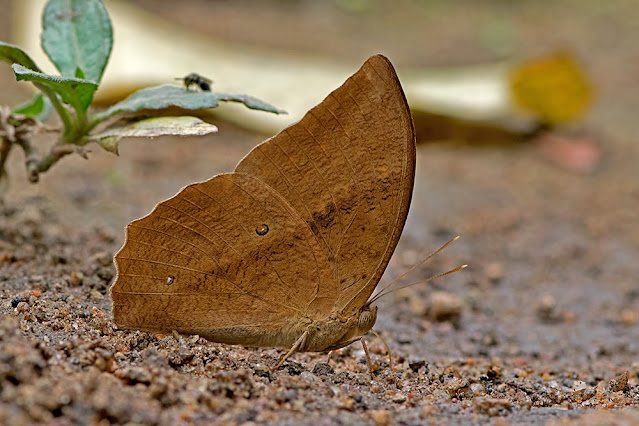
Photo taken at Lamnamkok National Park, Chiang Rai, Thailand ♂. 450m a.s.l.

Discophora sondaica is widely distributed across almost the whole of the region and is quite common. There are only minor differences visually between the sexes but the female is slightly larger. It is basically a forest species that prefers the shade. It is a fairly weak flier and is usually seen on the ground or fairly low down amongst the undergrowth.
The species is multivoltine with several broods per annum and the early instar larvae are gregarious.
Synonyms and previously used names: Discophora tullia, Papilio tullia, Discophora spiloptera, Discophora muscina
Taxonomy: Animalia - Arthropoda - Insecta - Lepidoptera - Nymphalidae - Satyrinae - Discophora - sondaica
Regional Subspecies: Discophora sondaica camdao (Philippines), D.sondaica despoliata (S.Thailand, W.Malaysia, Singapore), D.s.samarana (Philippines), D.s.semperi (Philippines), D.s.sondaica (Java-Indonesia), D.s.symphronia (Indonesia), D.s.tulliana (S.China, Vietnam, Taiwan), D.s.zal (India, Myanmar, Thailand, Laos, Cambodia)
Regional Distribution: Nepal, Bhutan, India, Bangladesh, Myanmar, Thailand, Laos, Cambodia, Vietnam, China, Taiwan, Malaysia, Singapore, Indonesia, Philippines
 |
Doi Suthep-Pui National Park, Chiang Mai, Thailand. c.1200m a.s.l. |
Habitat: Discophora sondaica is found in bamboo and broadleaf montane forest. It has been recorded up to 1200m a.s.l.
Flight time: all year depending on location Wingspan: 70-90mm
Life History: egg 7-9 days full details are not known but total larval stage is 46 days pupa 10-12 days Total egg to adult 63-67 days.
All times are approximate and can vary depending on the season and on the host used.
Larval Hosts: Bambusa multiplex, Bambusa oldhamii, Bambusa spinosa, Bambusa tuldoides, Bambusa ventricosa, Bambusa vulgaris, Dendrocalamus asper, Dendrocalamus latiflorus, Imperata cylindrica, Oligostachyum shiuyingianum, Phyllostachys makinoi, Pogonatherum crinitum, Pseudosasa hindsii, Saccharum officinarum, Schizostachyum dumetorum, Schizostachyum grande (Poaceae).
Actual host plant used depends upon location and availabilty of plant species.
Adult Food Sources: Nectar - not known to be a regular nectar feeder but has been recorded on Lantana camara (Verbenaceae). Other - mud puddling, animal dung, over-ripe fruit (especially Melastoma malabathricum)
 |
| Lamnamkok N.P., Chiang Rai, Thailand |
 |
| Doi Suthep-Pui N.P., Chiang Mai, Thailand |
 |
| Ob Khan N.P., Chiang Mai, Thailand |
 |
| Lamnamkok N.P., Chiang Rai, Thailand |
 |
| Bambusa vulgaris, a popular larval host |
 |
| Imperata cylindrica, another larval host |
Links to other pages in this series for species in the same subfamily
Stichophthalma louisa
