
<> Argynnis hyperbius (Linnaeus, 1763) <>
the Indian Fritillary ผีเสื้อลายเขาสูง
Click on any photo to see all photos full size in Lightbox
Additions and corrections to the information provided on this page is always welcome. Please use the Contact form.
2.jpg "Argynnis hyperbius")
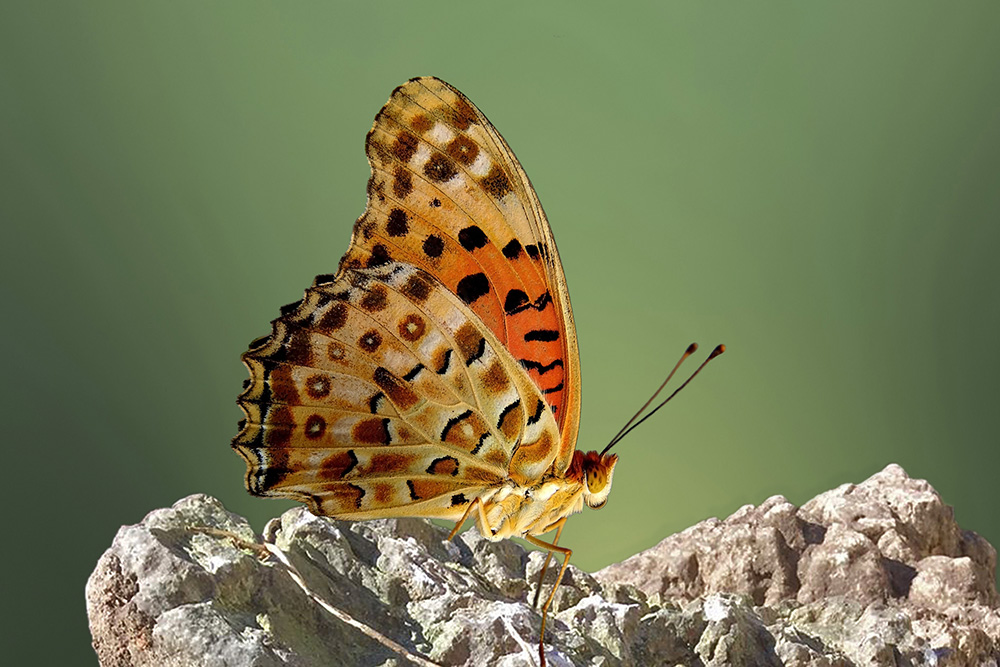
Photo taken at Sri Lanna National Park, Chiang Mai, Thailand ♀ 420m a.s.l.
2.jpg "Argynnis hyperbius")
Argynnis hyperbius is a fairly widespread species but not that common. The sexes are different in appearance as can be seen in the photos below. It sometimes basks with wings only 3/4 open. It is a fast flier and the species is multivoltine with several broods per annum. More study of this species is needed.
Synonyms: Papilio hyperbius, Argyreus hyperbius, Papilio niphe, Papilio argyrius, Papilio argynnis, Papilio tigris, Argynnis tephnia, Argynnis aruna, Argynnis hybrida, Argynnis montorum, Argynnis castetsoides, Argynnis coomani, Argynnis castetsi, Argynnis niphe, Argynnis inconstans
Taxonomy: Animalia - Arthropoda - Insecta - Lepidoptera - Nymphalidae - Heliconiinae - Argynnis - hyperbius
Regional subspecies: Argynnis hyperbius centralis (Indonesia), Argynnis hyperbius hyperbius (Nepal, N.India, Myanmar, Thailand, Laos, Vietnam, S.China, Taiwan), Argynnis hyperbius javanica (Java-Indonesia), Argynnis hyperbius sagada (Philippines), Argynnis hyperbius sumatrensis (W.Malaysia, Sumatra-Indonesia)
Regional Distribution: India, Nepal, Myanmar, Thailand, Laos, Vietnam, China, Malaysia, Indonesia, Philippines
Habitat: Argynnis hyperbius is found in open montane forests and open grassland, usually in the vicinity of streams. It has been recorded at elevations up to 3500m a.s.l. in Nepal.
Flight time: all year depending on location Wingspan: 65-80mm
Life History: egg 13 days instar 1 4 days instar 2 5 days instar 3 6 days instar 4 5 days instar 5 5 days pupa 15-17 days Total egg to adult 23-47 days. All times approximate.
Larval Hosts: Antirrhinum majus (Scrophulariaceae), Viola betonicifolia, Viola diffusa, Viola formosana, Viola grypoceras, Viola hamiltoniana, Viola inconspicua, Viola keiskei, Viola mandshurica, Viola nagasawae, Viola odorata, Viola patrinii, Viola philippica, Viola pilosa, Viola selkirkii, Viola tricolor (Violaceae). Actual host plant used depends upon location and availabilty of plant species.
Adult Food Sources: Nectar - Mimosa diplotricha (Mimosaceae), Stachytarpheta jamaicensis (Verbenaceae), Zanthoxylum avicennae (Rutaceae), Tagetes erecta (Asteraceae), Vaccinium retusum (Vaccinaceae), Fragaria nubicola (Rosaceae), Coelogyne corymbosa (Orchidaceae), Rhododendron grande (Ericaceae), Cyananthus incanus (Campanulaceae), Cuphea hyssopifolia (Lythraceae). Other - mud puddling.
.jpg "Argynnis hyperbius") |
| Lamnamkok N.P., Chiang Rai, Thailand ♂ |
 |
| Lamnamkok N.P., Chiang Rai, Thailand |
 |
| Lamnamkok N.P., Chiang Rai, Thailand ♀ |
.jpg "Argynnis hyperbius") |
| Lamnamkok N.P., Chiang Rai, Thailand ♀ |
 |
| Coelogyne corymbosa, a nectar source |
 |
| Viola hamiltoniana, a regular larval host |
 |
| Cuphea hyssopifolia, another nectar source |
Links to other pages in this series for species in the same subfamily
Cupha erymanthis
Terinos terpander
