
<> Vagrans sinha (Kollar,[1844]) <>
the Vagrant ผีเสื้อพเนจร
Click on any photo to see all photos full size in Lightbox
Additions and corrections to the information provided on this page is always welcome. Please use the Contact form.
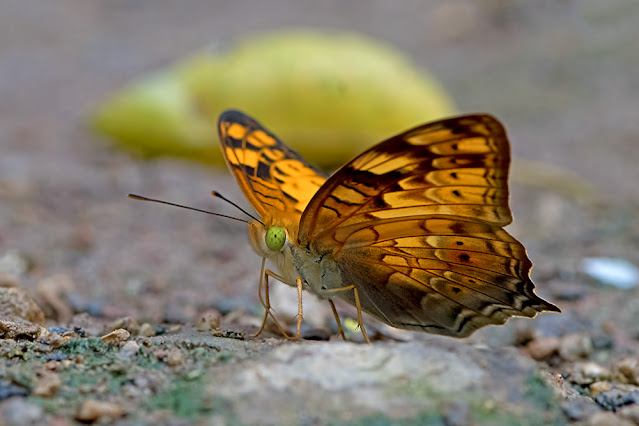
Photo taken at Pha Dang National Park, Chiang Mai, Thailand. 600m a.s.l.

Vagrans sinha is forest dependant and is quite common and widespread across the region. It is not a particularly strong flier but is usually very active and difficult to get close to. Sexes are very similar in appearance. Both sexes visit flowers for nectar and males are often seen puddling near streams or puddles.
The species is multivoltine with several broods per annum. Eggs are laid singly on plants adjacent to the host plant or on twigs or other debris at the foot of the host but not on the host itself. Larvae eat their eggshell as a first meal.
There is a difference of opinion about the taxonomy of this species, some considering it to be Vagrans egista sinha.
Synonyms: Issoria sinha, Terinos sinha, Vagrans egista
Taxonomy: Animalia - Arthropoda - Insecta - Lepidoptera - Nymphalidae - Heliconiinae - Vagrans - sinha
Regional subspecies: Vagrans sinha creaghana (E.Malaysia), Vagrans sinha nupta Sulawesi-Indonesia), Vagrans sinha sinha (Nepal, Bhutan, India, Bangladesh, Myanmar, Thailand, Laos, Cambodia, Vietnam, China, W.Malaysia, Singapore, Indonesia, Palawan-Philippines)
Regional Distribution: Nepal, Bhutan, India, Bangladesh, Myanmar, Thailand, Laos, Cambodia, Vietnam, China, Malaysia, Singapore, Indonesia, Philippines
Habitat: Vagrans sinha is found in montane and secondary forest at low to moderate elevations. It has been recorded at elevations up to 1400m a.s.l.
Flight time: all year depending on location Wingspan: 55-65mm
Life History: not known
Larval Hosts: Flacourtia indica, Flacourtia inermis, Flacourtia rukam, Homalium ceylanicum, Homalium cochinchinense, Homalium tomentosum, Xylosma longifolia (Salicaceae), Dillenia excelsa (Dilleniaceae)
Actual host plant used depends upon location and availabilty of plant species.
Adult Food Sources: Nectar - Chromolaena odorata, Mikania micrantha (Asteraceae), Polygonum hydropiper (Polygonaceae), Lantana camara (Verbenaceae). There may be other nectar sources although this species is not seen visiting flowers very often. Other: mud puddling, animal dung and urine.
 |
| Chiang Dao N.S., Chiang Mai, Thailand |
 |
| Chiang Dao N.S., Chiang Mai, Thailand |
 |
| Doi Suthep-Pui N.P., Chiang Mai, Thailand |
 |
| Chiang Dao N.S., Chiang Mai, Thailand |
%20galleryNU.jpg "Vagrans sinha") |
| Doi Suthep-Pui N.P., Chiang Mai, Thailand |
 |
| Flacourtia rukam, a regular larval host |
 |
| Polygonum hydropiper, a nectar source |
Links to other pages in this series for species in the same subfamily
