
<> Euripus consimilis Westwood,1850 <>
the Painted Courtesan ผีเสื้อปีกเว้าแต้มแดง
Click on any photo to see all photos full size in Lightbox
Additions and corrections to the information provided on this page is always welcome. Please use the Contact form.
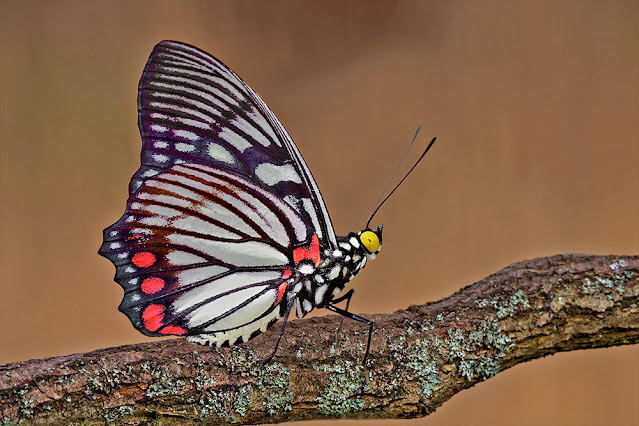
Photo taken in Lamnamkok National Park, Chiang Rai, Thailand ♂ 450m a.s.l.

Euripus consimilis is uncommon and found mainly in the western half of the region. The species is sexually dimorphic with the wings of the female having larger white areas and no red spots. This is one of the larger members of this subfamily but little is known about it and more research is needed. It is multivoltine but it is not known how many broods there are each year.
Synonyms and previously used names: Euripus hallirothius, Diadema consimilis
Taxonomy: Animalia - Arthropoda - Insecta - Lepidoptera - Nymphalidae - Apaturinae - Euripus - consimilis
Regional subspecies: Euripus consimilis eurinus (Myanmar, Thailand, Laos), Euripus consimilis yunnanensis (N.Vietnam, Yunnan-China)
Regional Distribution: India, Nepal, Bhutan, Myanmar, Thailand, Laos, Vietnam
Habitat: Euripus consimilis is found in evergreen and deciduous montane forest at low to mid elevations, up to 1000m a.s.l.
Flight time: March-December Wingspan: 70-85mm
Life History: not known
Larval Hosts: Trema orientale (Cannabaceae), Albizia chinensis (Fabaceae). There may be other plant species not yet recorded.
Adult Food Sources: Nectar - Lantana sp. (Verbenaceae). There may be other nectar sources yet to be recorded. Other - not known
 |
| Lamnamkok N.P., Chiang Rai, Thailand ♂ |
 |
| Trema orientalis a larval host |
 |
| Lantana sp. a nectar source |
Links to other pages in this series for species in the same subfamily
Hestina persimilis
Rohana parisatis
