
<> Cyrestis thyodamas Doyere,[1840] <>
the Common Map ผีเสื้อแผนที่ธรรมดา
Click on any photo to see all photos full size in Lightbox
Additions and corrections to the information provided on this page is always welcome. Please use the Contact form
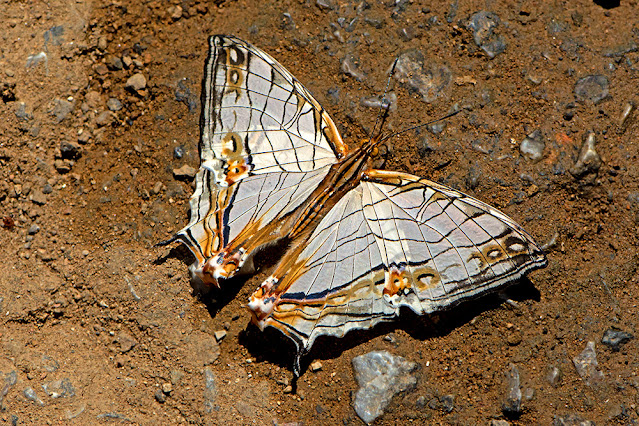
Photo taken at Chiang Dao Nature Sanctuary, Chiang Mai, Thailand. 540m a.s.l.

Cyrestis thyodamas is widespread and very common everywhere in the region. Surprisingly, there appears to have been no research into the life history of this species. Both sexes are similar in size and appearance although the female has a little more yellow on the wings. It has a slow, gliding flight. Both sexes habitually rest beneath leaves with their wings outspread but when basking on the ground they usually have their wings widespread and pressed flat against the ground. This is quite unusual and I know of few other butterflies that do this.
The species is multivoltine with a number of broods per annum. The common name is derived from the intricate network of black lines on its wings that resemble geographical maps with latitude and longitude markings. It is truly a striking example of natural artistry.
Synonyms and other previously used names: Cyrestis chinensis
Taxonomy: Animalia - Arthropoda - Insecta - Lepidoptera - Nymphalidae - Cyrestinae - Cyrestis - thyodamas
Regional subspecies: Cyrestis thyodamas chinensis (SW China), Cyrestis thyodamas formosana (Taiwan), Cyrestis thyodamas thyodamas (most locations)
Regional Distribution: Nepal, Bhutan, India, Bangladesh, Myanmar, Thailand, Laos, Cambodia, Vietnam, China, Taiwan, Indonesia
Habitat: Cyrestis thyodamas is usually found in shaded evergreen and deciduous montane forest up to around 1000m a.s.l. It has however been recorded at elevations up to 3000m a.s.l. in Nepal.
Flight time: all year, depending on location Wingspan: 45-68mm
Life History: is not known but the cycle is likely to be quite short and similar to other species in the same subfamily.
Larval Hosts: Ficus ampelos, Ficus benghalensis, Ficus callosa, Ficus carica, Ficus caulocarpa, Ficus drupacea, Ficus erecta, Ficus formosana, Ficus microcarpa, Ficus neriifolia, Ficus pumila, Ficus racemosa, Ficus religiosa, Ficus sarmentosa, Ficus semicordata, Ficus septica, Ficus superba, Ficus tinctoria, Ficus variegata, Ficus vasculosa, Ficus virens, Ficus virgata (Moraceae), Debregeasia sp. (Urticaceae), Tetracera sarmentosa (Dilleniaceae).
Actual host plant used depends upon location and availabilty of plant species.
Adult Food Sources: Nectar - Zanthoxylum avicennae (Rutaceae), Lantana camara (Verbenaceae), Anaphalis contorta (Asteraceae), Cyananthus incanus (Campanulaceae), Swertia chirata (Gentianaceae), Osbeckia nepalensis (Melastomataceae), Coelogyne corymbosa (Orchidaceae), Narcissus tazetta (Amaryllidaceae), Berberis asiatica, Berberis chitria, Berberis lycium (Berberidaceae). Other - mud puddling, rotting fruit
 |
| Doi Suthep-Pui N.P., Chiang Mai, Thailand |
 |
| Doi Suthep-Pui N.P., Chiang Mai, Thailand |
 |
| Doi Suthep-Pui N.P., Chiang Mai, Thailand |
 |
| Doi Suthep-Pui N.P., Chiang Mai, Thailand |
 |
| Lamnamkok N.P., Chiang Rai, Thailand |
 |
| Swertia chirata, a nectar source |
 |
| Lamnamkok N.P., Chiang Rai, Thailand |
 |
| Ficus erecta, an often used larval host |
 |
| Ficus microcarpa, another larval host |
Links to other pages in this series for species in the same subfamily and the closely related Pseudergolinae
Cyrestis thyodamas
