
<> Cyrestis themire Honrath,1884 <>
the Little Mapwing ผีเสื้อแผนที่เล็ก
Click on any photo to see all photos full size in Lightbox
Additions and corrections to the information provided on this page is always welcome. Please use the Contact form.
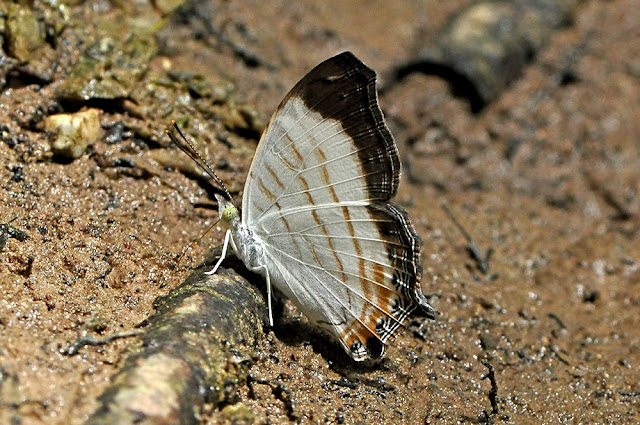
Photo taken at Than Bok Khorani National Park, Krabi, Thailand. 60m a.s.l.

Cyrestis themire can be fairly common locally but is not seen everywhere. Both sexes are similar in appearance. It often rests on the underside of leaves. There is not a great deal known about this species and more study needs to be done.
The species is multivoltine and has a short lifecycle. There are likely to be many broods per annum. Eggs are laid singly on young leaves of the host plant. Newly hatched larvae consume the remains of the eggshell before they start feeding on the leaves of the host plant.
Synonyms: Papilio periander, Cyrestis wernickei, Cyrestis periander, Cyrestis vatinia
Taxonomy: Animalia - Arthropoda - Insecta - Lepidoptera - Nymphalidae - Cyrestinae - Cyrestis - themire
Regional subspecies: Cyrestis themire deboeri (Bali-Indonesia), Cyrestis themire horsfieldi (Java-Indonesia), Cyrestis themire themire (Myanmar, Thailand, Cambodia, W.Malaysia), Cyrestis themire vatinia (Laos, Vietnam, Yunnan-China). There are a number of subspecies listed on various islands in Indonesia but it is not known how many are valid.
Regional Distribution: Myanmar, Thailand, Laos, Cambodia, Vietnam, China, Malaysia, Indonesia
Habitat: Cyrestis themire is found in open forest and forest edges, mostly at low elevations but has been recorded up to 1000m a.s.l.
Flight time: all year, depending on location Wingspan: 35-45mm
Life History: egg 3 days instar 1 2 days instar 2 1 day instar 3 1 day instar 4 2 days instar 5 2 days pupa 5-6 days Total egg to adult 16-18 days
All times are approximate and can vary depending on the season and on the host used.
Larval Hosts: Ficus obscura, Taxotrophis ilicifolia (Moraceae), ?Tetracera sarmentosa (Dilleniaceae) There may be others species that have not yet been recorded.
Adult Food Sources: Nectar - may occasionally visit flowers but none recorded. Other - mud puddling
 |
| Than Bok Khorani N.P., Krabi, Thailand |
 |
| Ficus obscura, a larval host |
 |
| Taxotrophis ilicifolia, another larval host |
Links to other pages in this series for species in the same subfamily
