
<> Polyura jalysus (Felder,[1867]) <>
the Indian Yellow Nawab ผีเสื้อม้าเขียวแถบกว้าง
Click on any photo to see all photos full size in Lightbox
Additions and corrections to the information provided on this page is always welcome. Please use the Contact form.
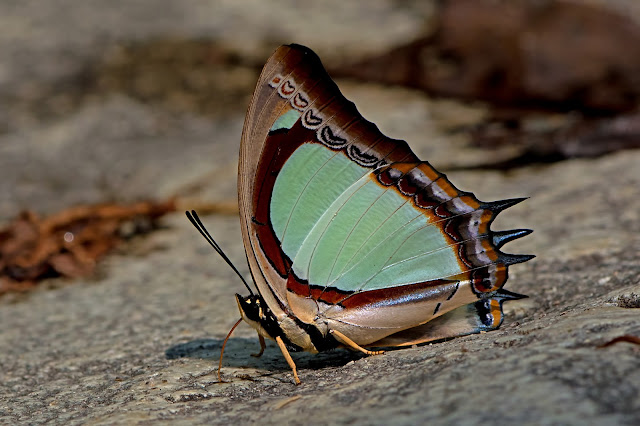
Photo taken at Doi Suthep-Pui National Park, Chiang Mai, Thailand. 450m a.s.l.

Polyura jalysus is an uncommon and little known species that is usually seen when feeding near streams. When feeding they are almost oblivious of humans, but if they are disturbed they fly up to settle on tree foliage nearby, and return as soon as they sense danger has passed. Both sexes are similar in appearance but there may be some variation in size. It has a strong and rapid flight and is usually in the tree tops unless feeding. Females are rarely seen.
Synonyms: Eriboea jalysus
Taxonomy: Animalia - Arthropoda - Insecta - Lepidoptera - Nymphalidae - Charaxinae - Polyura - jalysus
Regional subspecies: Polyura jalysus ephebus (Myanmar, W.Thailand), Polyura jalysus jalysus (Thailand, Laos, Cambodia, Vietnam, W.Malaysia, Sumatra-Indonesia), Polyura jalysus triphonus (E.Malaysia)
Regional Distribution: India, Myanmar, Thailand, Laos, Cambodia, Vietnam, Malaysia, Singapore, Indonesia
Habitat: Polyura jalysus is found in montane forest at low to moderate elevations. It has been recorded up to around 1400m a.s.l.
Flight time: most of the year depending on location Wingspan: 50–65mm
Life History: not known
Larval Hosts: not known but most likely species from the Fabaceae family.
Adult Food Sources: Nectar - not known to visit flowers. Other - mud puddling, over-ripe fruit
 |
| Doi Suthep-Pui N.P., Chiang Mai, Thailand |
 |
| Doi Suthep-Pui N.P., Chiang Mai, Thailand |
Links to other pages in this series for species in the same subfamily
