
<> Prothoe franck (Godart, [1824]) <>
the Blue Begum ผีเสื้อเจ้าหญิงสีฟ้า
Click on any photo to see all photos full size in Lightbox
Additions and corrections to the information provided on this page is always welcome. Please use the Contact form.
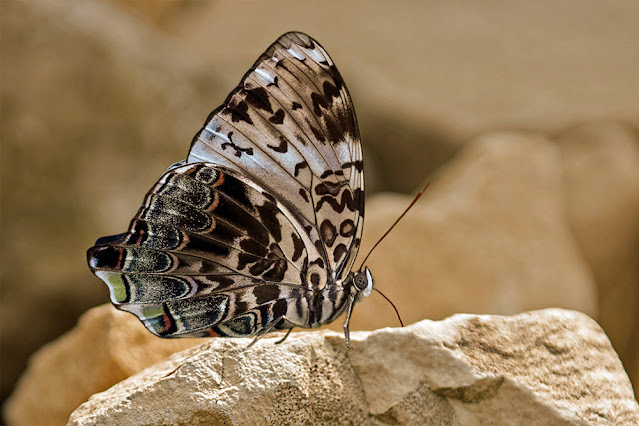
Photo taken at Lamnamkok National Park, Chiang Rai, Thailand. 450m a.s.l.

Prothoe franck is a fairly rare species that, like many species in this subfamily, is usually seen individually and not in groups. Both sexes are similar in appearance. It is multivoltine but number of broods per annum is unknown. More study is needed.
Synonyms: Prothoe franckii, Prothoe nausikaa
Taxonomy: Animalia - Arthropoda - Insecta - Lepidoptera - Nymphalidae - Charaxinae - Prothoe - franck
Regional subspecies: Prothoe franck angelica (S.Myanmar, W.Thailand), Prothoe franck aphrodite (Palawan-Philippines), Prothoe franck irma (Indonesia), P.franck nausikaa (N.Vietnam, Yunnan-China), P.franck regalis (India, N.Myanmar), P.franck semperi (Philippines), P.franck uniformis (Thailand, Malaysia), P.franck vilma (C.Thailand, Laos, Vietnam)
Regional Distribution: India, Myanmar, Thailand, Laos, Vietnam, China, Malaysia, Indonesia, Philippines
Habitat: Prothoe franck is found in montane forest at low to moderate elevations. It has been recorded up to 800m a.s.l.
Flight time: most of the year, depending on location Wingspan: 55-75mm
Life History: not known
Larval Hosts: Alphonsea monogyna, Annona muricata, Desmos cochinchinensis, Friesodielsia cuneiformis (Annonaceae).
Adult Food Sources: Nectar - not known to visit flowers. Other - mud puddling, carrion, over-ripe fruit, tree sap
 |
| Lamnamkok N.P., Chiang Rai, Thailand |
 |
| Annona muricata, a larval host |
 |
| Alphonsea monogyna, another larval host |
Links to other pages in this series for species in the same subfamily
Polyura arja
Polyura eudamippus
Prothoe franck
