
<> Neptis nashona Swinhoe,1896 <>
the Long-stick Sailer ผีเสื้อกะลาสีไม้ยาว
Click on any photo to see all photos full size in Lightbox
Additions and corrections to the information provided on this page is always welcome. Please use the Contact form.
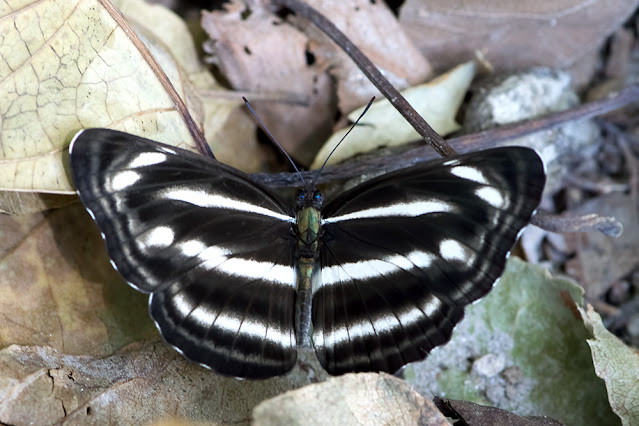
Photo taken at Doi Inthanon National Park, Chiang Mai, Thailand. 1060m a.s.l.

There is limited distribution of Neptis nashona and it is mainly in the northern parts of the region. Both sexes look similar to each other. It's flight is rather weak in typical 'sailer' fashion featuring bursts of rapid wing beats interspersed with extended gliding or sailing phases. It is a sun-loving species but is easily disturbed. It is known to be multivoltine but overall very little seems to be known about this species and further studies are needed.
Synonyms and previously used names: Neptis cartica nashona
Taxonomy: Animalia - Arthropoda - Insecta - Lepidoptera - Nymphalidae - Limenitidinae - Neptis - nashona
Regional subspecies: Neptis nashona aagaardi (N&C Thailand), Neptis nashona chapa (N.Vietnam), Neptis nashona kishii (N.Vietnam, Yunnan-China), Neptis nashona nashona (NE.India, Myanmar, NE Thailand, Laos, N.Vietnam), Neptis nashona tamamitsui (C&S Vietnam)
Regional Distribution: India, Bangladesh, Myanmar, Thailand, Laos, Vietnam, China
Habitat: Neptis nashona is found in montane forest, often near streams, and has been recorded at elevations up to 1600m a.s.l.
Flight time: not fully known, may be seasonal Wingspan: 50-60mm
Life History: full details are not known but the period from Egg to Adult is believed to be around 25-40 days, depending on the season.
Larval Hosts: not known
Adult Food Sources: Nectar - not known if this species visits flowers. Other - mud puddling
 |
| Doi Inthanon N.P., Chiang Mai, Thailand |
Links to other pages in this series for species in the same subfamily
Athyma perius
Auzakia danava
Euthalia alpheda
Euthalia lubentina
Lasippa viraja
Limenitis asura
Neptis cartica
Neptis miah
Pantoporia hordonia
Athyma daraxa
Athyma pravara
Bhagadatta austenia
Euthalia anosia
Euthalia monina
Lebadea martha
Limenitis dudu
Neptis clinia
Neptis nashona
Pantoporia paraka
Sumalia zulema
Athyma ranga
Cynitia cocytus
Euthalia evelina
Euthalia patala
Lexias dirtea
Moduza procris
Neptis hylas
Neptis nata
Parthenos sylvia
Tanaecia jahnu
Athyma selenophora
Euthalia aconthea
Euthalia franciae
Euthalia phemius
Lexias pardalis
Neptis ananta
Neptis magadha
Neptis soma
Phaedyma columella
Tanaecia julii
