
<> Phaedyma columella (Cramer,1780) <>
the Short-banded Sailer ผีเสื้อกะลาสีเทาแถบสั้น
Click on any photo to see all photos full size in Lightbox
Additions and corrections to the information provided on this page is always welcome. Please use the Contact form.
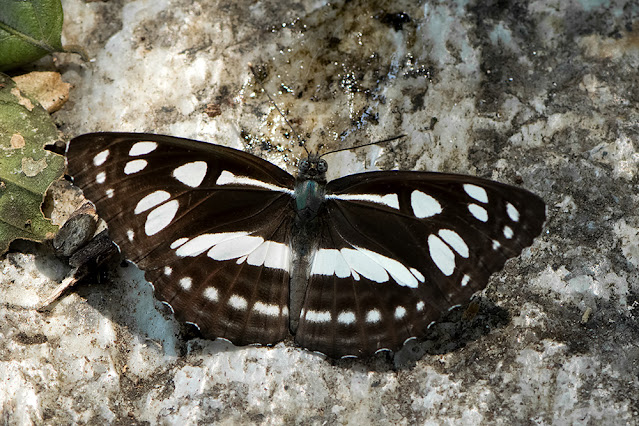
Photo taken at Doi Suthep-Pui National Park, Chiang Mai, Thailand. 460m a.s.l.

Phaedyma columella is widely distributed and common across the whole of the region except Taiwan. This species is visually similar to the Neptis genus but is larger. Male and female look alike but the species is variable, especially in relation to the seasons. It is multivoltine with several broods per annum. Usually found near rivers and streams.
Synonyms and previously used names: Neptis columella, Neptis tonkiniana
Taxonomy: Animalia - Arthropoda - Insecta - Lepidoptera - Nymphalidae - Limenitidinae - Phaedyma - columella
Regional Distribution: India, Nepal, Bhutan, Bangladesh, Myanmar, Thailand, Laos, Cambodia, Vietnam, China, Malaysia, Singapore, Indonesia, Philippines
Habitat: Phaedyma columella is usually found around evergreen and deciduous forest margins. It has been recorded at elevations up to 1500m a.s.l.
Flight time: all year, depending on location Wingspan: 55-65mm
Life History: egg 3-4 days instar 1 4 days instar 2 3-4 days instar 3 3-4 days instar 4 5-7 days instar 5 8-9 days pupa 6-7 days Total egg to adult 32-39 days.All times are approximate and can vary depending on the season and on the host used.
Larval Hosts: Gmelina arborea (Lamiaceae), Cratoxylum cochinchinense (Hypericaceae), Dalbergia spp., Grona reticulata, Pterocarpus indicus, Pueraria tuberosa, Tadehagi triquetrum (Fabaceae), Ceiba speciosa, Hibiscus mutabilis, Reevesia pubescens, Reevesia thyrsoidea, Sterculia foetida, Sterculia lanceolata, Sterculia urens, Hibiscus tiliaceus (Malvaceae), Sageretia thea (Rhamnaceae), Erythroxylum cuneatum (Erythroxylaceae)
Actual host plant used depends upon location and availabilty of plant species.
Adult Food Sources: Nectar - Cuphea hyssopifolia (Lythraceae), Ichnocarpus frutescens (Apocynaceae), Euphorbia hypericifolia (Euphorbiaceae), Ixora sp. (Rubiaceae), Zanthoxylum avicennae (Rutaceae), Leea alata (Vitaceae). There may be other nectar sources that have not been recorded. Other - mud puddling
 |
| Chiang Mai, Thailand |
 |
| Chiang Rai, Thailand |
 |
| Chiang Mai, Thailand |
 |
| Chiang Mai, Thailand |
 |
| Chiang Mai, Thailand |
 |
| Cuphea hyssopifolia, a nectar source |
 |
| Gmelina arborea, a larval host |
 |
| Cratoxylum cochinchinense, another larval host |
Links to other pages in this series for species in the same subfamily
Athyma perius
Auzakia danava
Euthalia alpheda
Euthalia lubentina
Lasippa viraja
Limenitis asura
Neptis cartica
Neptis miah
Pantoporia hordonia
Sumalia daraxa
Athyma pravara
Bhagadatta austenia
Euthalia anosia
Euthalia monina
Lebadea martha
Limenitis dudu
Neptis clinia
Neptis nashona
Pantoporia paraka
Sumalia zulema
Athyma ranga
Cynitia cocytus
Euthalia evelina
Euthalia patala
Lexias dirtea
Moduza procris
Neptis hylas
Neptis nata
Parthenos sylvia
Tanaecia jahnu
Athyma selenophora
Euthalia aconthea
Euthalia franciae
Euthalia phemius
Lexias pardalis
Neptis ananta
Neptis magadha
Neptis soma
Phaedyma columella
Tanaecia julii
